



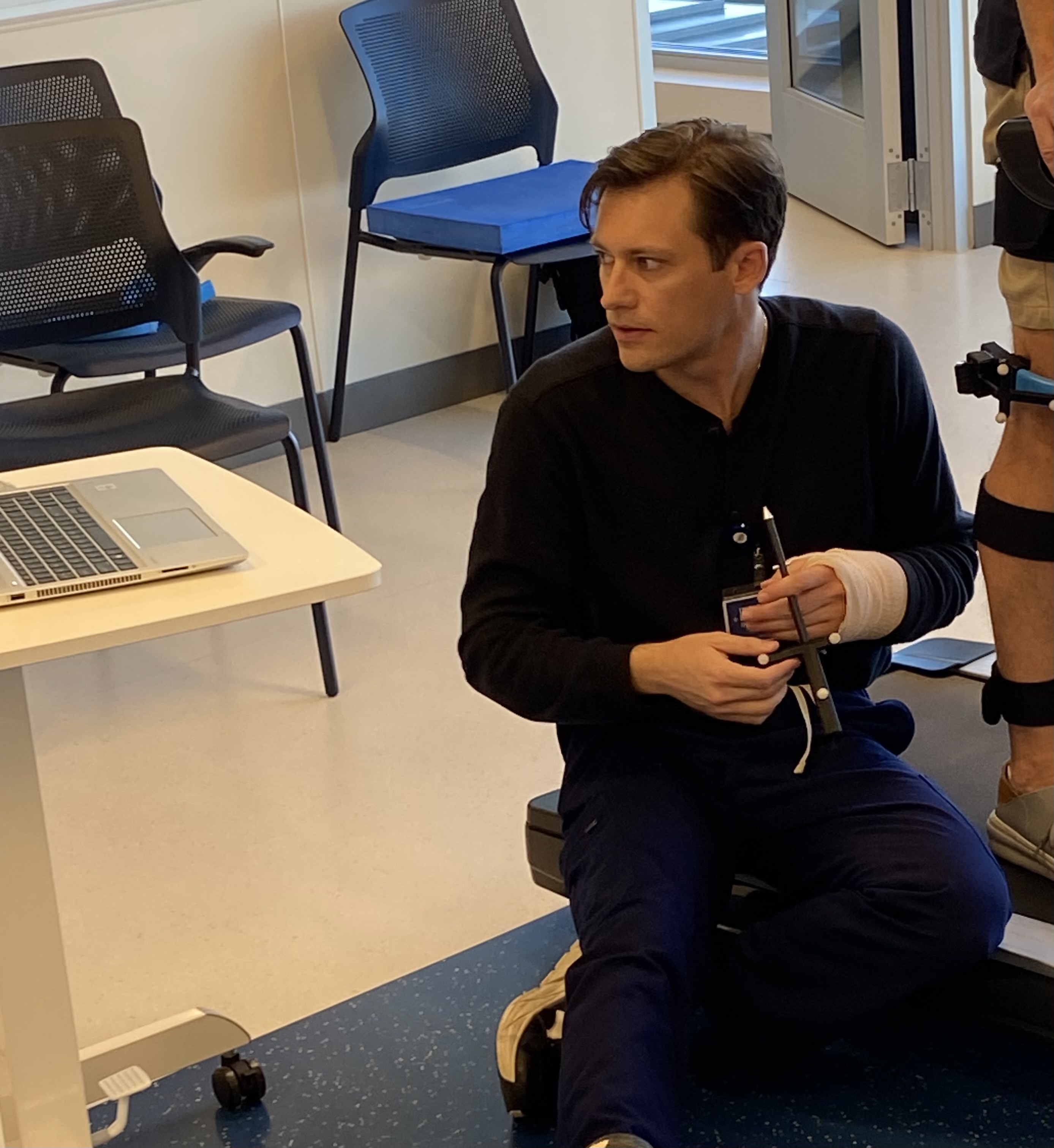
You could call IOI Clinical Research Analyst Matt Parmenter the "gait lab guy. "
Regularly on Wednesdays at IOI Noblesville, he works with patients, hooking up computer-guided cameras and sensors to knees and asking people to walk on a treadmill or perform basic knee movements.
The goal is to slowly build a database used for research. From there, IOI surgeons work with Director of Research Evan Deckard to design and conduct clinical research to be published and presented before peers.
The IOI Kinematic Gait Laboratory in Noblesville is one of the few in Indiana focused on knee replacement research. The goal of the gait lab is to understand knee motion before and after knee replacement to help guide surgeons on better techniques, implant designs, and optimal patient outcomes.
The data are then used in clinical studies such as IOI research presented by Dr. John Meding at the recent Annual Meeting of the American Association of Hip and Knee Surgeons in Dallas.
The study - by IOI's Dr. Meding, Deckard, and founder Dr. Michael Meneghini - found that patients with slower preoperative gait speed reported better improvements in tasks such as climbing stairs after knee replacement.
“Preoperative gait speed may provide a simple, objective marker to support patient counseling regarding meaningful postoperative improvement,” the IOI researchers concluded.
Another recent study based on data collected at the IOI gait lab, presented by Dr. Meneghini at the Knee Society, looked at side-to-side knee stability in patients undergoing knee replacement.
Such research allows IOI surgeons to study how the knee bends, slides, and rotates in motion - in addition to static X-rays - before and after surgery to continually improve patient outcomes.
To learn more about IOI's research and education initiatives, visit indianaortho.com/research-fellowship.